
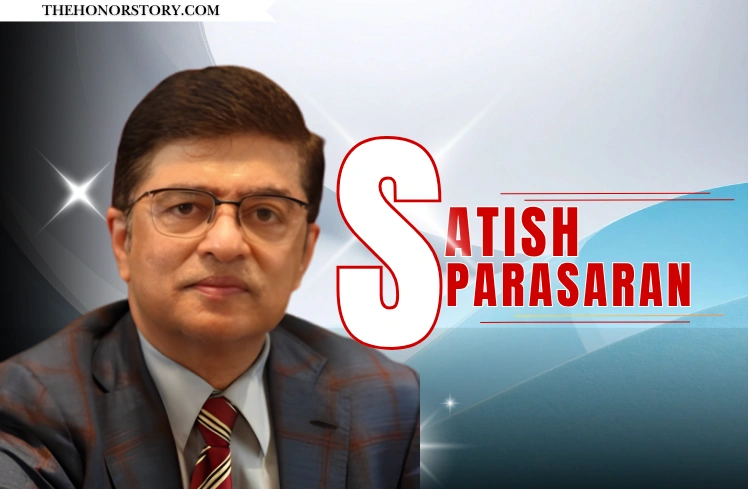
You know how some people just walk into a room and everything changes? The energy shifts, people sit up straighter, conversations drop to a hush. Well, Satish Parasaran walks into a courtroom and that’s exactly what happens — except replace “hush” with furious note-taking.
Here’s a real story that tells you everything. A lawyer once spotted a colleague carrying two completely empty notebooks into the Company Law Board (CLB). “Why the blank notebooks?” he asked. The reply? “Satish Parasaran is arguing today. You’re not supposed to miss noting even his banter with the bench.”
That, right there, is the kind of reputation that takes decades to build and zero days to explain. Satish Parasaran isn’t just a senior advocate — he is an institution, a courtroom legend, and the kind of lawyer who makes opposing counsel lose sleep. And if you’ve been curious about who this man really is, what shaped him, and why he matters so much to Indian law, you’re in the right place.
Quick Stats: Who Is Satish Parasaran?
| Category | Details |
|---|---|
| Full Name | Satish Parasaran |
| Profession | Senior Advocate |
| Primary Court | Madras High Court; also appears before Supreme Court of India |
| Designation Year | 2016 (designated Senior Advocate by Madras High Court) |
| Father | K. Parasaran — former Attorney General of India (1983–1989), Padma Vibhushan awardee |
| Brother | Mohan Parasaran — former Solicitor General of India (2013–2014) |
| Family Legal Legacy | 4th generation of the Parasaran family has joined the Bar |
| Legal Education | Campus Law Centre, Delhi (LL.B.) |
| Enrolled as Advocate | September 1992, Tamil Nadu Bar Council |
| Notable Areas of Practice | Constitutional Law, Civil Law, Corporate/Commercial Law, Tax Law |
| Known For | Razor-sharp legal acumen, wit in court, powerful oral arguments |
Born Into Legal Royalty — And He Earned Every Bit of It Anyway
Let’s talk about the family tree, because it’s the kind of lineage that makes law school students feel slightly inadequate.
- Satish Parasaran is the son of K. Parasaran — a man so revered in Indian legal circles that he’s been called the “Pitamah of the Indian Bar.” K. Parasaran served as the Attorney General of India from 1983 to 1989, was awarded the Padma Bhushan in 2003 and the Padma Vibhushan in 2011, and famously argued the Ayodhya land dispute case for the Hindu parties — barefoot — because that’s the level of devotion this family brings to everything they do.
- Satish’s older brother, Mohan Parasaran, served as the Solicitor General of India from 2013 to 2014. In fact, the Parasaran family’s legal lineage spans generations — K. Parasaran himself is the son of a lawyer, Kesava Iyengar, and the family’s fourth generation has also joined the Bar.
- Now here’s where it gets interesting: being born into this family could easily have opened every door. But Satish Parasaran didn’t ride his father’s coattails. In fact, there’s a delightful story from his law school days at the Campus Law Centre in Delhi that proves exactly that.
- When Satish forgot to pay his examination fee on time and faced being barred from his LL.B. exams, he went to his father — then the recently retired Attorney General of India — and asked him to put in a word. His father flatly refused. No favours. No backdoor. Nothing. K. Parasaran, the most powerful lawyer in the country at the time, would not pull strings even for his own son.
- In a world of nepotism and shortcut-taking, that one “no” may have been the most valuable thing a father ever gave his child. It told Satish: earn it yourself. And that’s precisely what he did.
The Early Years: Mistakes, Masterclasses, and a Verbal Lashing From a Judge
- Satish Parasaran enrolled as an advocate at the Tamil Nadu Bar Council in September 1992 — and true to the tradition of his office, he was thrown into the deep end almost immediately.
- Just days after his enrolment, he appeared before Justice K.S. Bhakthavatsalam in a writ petition. He didn’t know it at the time, but he couldn’t have picked a kinder judge for his first outing. The result? Despite Satish barely managing to make himself heard above his own nerves, the judge admitted the case and granted an interim order. A lucky start.
- But Week Two? Not so lucky.
- A contempt petition against the Madras Race Club came up before a Division Bench of Justice Venkatasamy and Justice Abdul Hadi. Neither of the seniors from his office showed up. Young Satish Parasaran, in a moment of blissful ignorance, stood up and casually requested a two-week adjournment — completely unaware this was a special bench assembled specifically for this matter.
- What followed was a verbal lashing from Justice Venkatasamy that felt like five minutes but seemed like an hour. Justice Hadi joined in for good measure. It was, by all accounts, a thorough and enthusiastic roasting.
- The lesson Satish drew from this wasn’t bitterness — it was discipline. He never entered a courtroom again without having read the entire case, even if his only job was to keep watch until a senior arrived. That lesson, learned in the fire of public embarrassment in Week Two of his career, likely made Satish Parasaran the formidable advocate he is today.
- There’s another brilliant early-career story worth telling — and it’s almost detective-novel material. A client from Mahe approached Satish’s office after his kerosene dealership application was rejected by an Oil Selection Board headed by a retired High Court judge. Satish, barely two years into practice, noticed something odd: the rejection letter mentioned the location of the interview — information that had no business being in a rejection letter.
- He held both the interview letter and the rejection letter up to the light. The typed portions matched perfectly. Both letters had been typed simultaneously, with carbon paper between them. The man’s fate had been decided before he’d even sat down for his interview.
- Satish moved the writ petition before a notoriously tough judge and demonstrated this discovery. The judge was so taken aback he immediately granted an interim stay. Satish was thrilled.
- Then came the counter-affidavit. The retired judge admitted everything — but explained that with only two clerks and hundreds of applicants, it was physically impossible to type interview letters and then wait to type rejection letters individually. The rejection letters were typed alongside the interview letters as a matter of administrative practicality, with only the successful candidates’ rejection letters later destroyed.
- The case was dismissed. Satish’s open-and-shut victory had crumbled on a perfectly reasonable administrative explanation.
- The lesson? First impressions in law can be spectacularly wrong, and underestimating your adversary — however obvious their guilt appears — is a rookie mistake. Satish Parasaran never made it again.
The Designation That Took 3 Years to Come — And Was Worth the Wait
- In 2016, the Madras High Court designated 12 lawyers as Senior Advocates — its first such batch of designations in three years. Satish Parasaran was among those 12.
- This designation is not given lightly. Under the Advocates Act, 1961, the designation of “Senior Advocate” is conferred by the Supreme Court or a High Court on advocates who, by virtue of their ability, standing at the Bar, or special knowledge or experience in law, are considered deserving of such distinction. It is, in short, the legal profession’s version of being knighted.
- The three-year gap before that 2016 designation batch underlines just how selective the process is. For Satish Parasaran to be included in that list was not merely recognition — it was the court’s formal acknowledgement of what the legal fraternity had known for years: that this man belonged in the highest tier of advocacy.
- His courtroom practice spans constitutional matters, civil disputes, corporate and commercial litigation, and tax law — a breadth that’s rare and reflects years of relentless preparation and intellectual versatility.
Expert Insight: Senior Advocate designation in Indian courts is not an exam you pass — it’s a reputation you build, argument by argument, year by year. It requires not just legal knowledge but the ability to stand in an adversarial forum, under pressure, and make complex law both compelling and accessible to the bench.
The Parasaran Courtroom Effect: Why Lawyers Take Notes on His Jokes
- Let’s come back to those empty notebooks.
- The story — a junior lawyer told to take notes even during Satish Parasaran’s banter with the bench — speaks to something that very few advocates achieve: the ability to make even the margins of their courtroom performance worth studying.
- In legal circles, oral advocacy is an art form that is increasingly undervalued in the age of written submissions and email filings. The ability to hold a bench’s attention, construct an argument in real time, respond to judicial interruptions with grace and precision, and do all of this while making the law feel urgent and alive — that’s what separates the good from the great.
- By every account, Satish Parasaran operates squarely in the “great” category. Colleagues and juniors describe a presence in court that commands attention not through volume or aggression but through the quality of his reasoning and, remarkably, his wit. Even his exchanges with judges — casual, quick, intelligent — were apparently considered educational enough to warrant documentation.
- This is the kind of professional reputation that no LinkedIn profile can capture and no press release can manufacture. It’s built one hearing at a time, in rooms where only lawyers and judges are watching, over the course of a three-decade career.
The Legacy in Context: A Family That Shaped Indian Law
- To truly understand Satish Parasaran, you need to understand the family that produced him — because it’s not just biography, it’s context for an entire legal philosophy.
- K. Parasaran, his father, was not just the Attorney General. He was the man who walked into the Supreme Court during the Ayodhya hearings in his nineties, barefoot, and delivered arguments that changed the course of Indian legal and cultural history. He represented the Bhopal gas tragedy victims before the courts. He argued before the United Nations Human Rights Commission in New York on India’s behalf. He was described by the Supreme Court itself as the “Pitamah of the Indian Bar.”
- Mohan Parasaran, Satish’s brother, served as Solicitor General of India, having also held the position of Additional Solicitor General for nine years prior. Both brothers studied at the University of Madras and went on to carve careers of genuine distinction — not riding their father’s name but building on the values he instilled.
- And Satish? He chose a different path from his brother’s government law officer roles. He built his practice at the Bar itself — appearing in Madras High Court and before the Supreme Court — accumulating a case history that spans hundreds of matters across diverse areas of law.
- What’s remarkable about the Parasaran family is that their success has never been a story of access or privilege weaponised. It has been a story of standards — incredibly high standards, passed down like heirlooms. When K. Parasaran refused to help his son get his hall ticket sorted, he was doing what every great mentor does: forcing the next generation to develop their own problem-solving muscles.
- That refusal produced Satish Parasaran: a senior advocate whose reputation is entirely, completely, and gloriously his own.
What Makes Satish Parasaran Different? An Honest Assessment
- Here’s the thing about great lawyers — they’re not great because they know more law than everyone else, though they certainly do. They’re great because they know how to use what they know. The law is a tool; the courtroom is a workshop; and the advocate is the craftsman.
- Satish Parasaran is, by all accounts, an exceptional craftsman.
- His early career stories reveal a man who learned from every mistake — and there were mistakes, glorious, embarrassing, hilarious ones — and who never stopped preparing. His approach to practice reflects a discipline that was clearly shaped both by the family he grew up in and by the hard knocks of those first years at the Bar.
- He’s also accessible. In a profession where senior advocates can become mythological figures — remote, intimidating, unreachable — Satish Parasaran has reportedly been the kind of senior who other lawyers find approachable. That matters more than it sounds. Mentorship and accessibility are how the knowledge of one generation gets transferred to the next. The fact that colleagues speak of him with warmth, not just awe, says something important about the man behind the wig.
Satish Parasaran and the Future of Indian Advocacy
- India’s legal system is undergoing enormous change. Digital courts, AI-assisted legal research, online dispute resolution, and a rapidly expanding caseload are transforming how law is practised. But the core of what makes advocacy valuable — the ability to think clearly, argue persuasively, and represent clients with integrity — that hasn’t changed, and it won’t.
- In that sense, the career of Satish Parasaran is not just a biography. It’s a blueprint. It says: start young, make mistakes, learn from them, prepare obsessively, never coast on family reputation, and let your arguments speak for you.
- The Indian Bar has produced many great lawyers. The Parasaran family alone has contributed several of them. But what makes Satish Parasaran worth writing about — and worth reading about — is that his story is genuinely instructive. Not just for law students or young advocates, but for anyone who wants to understand what it means to build a career on craft, character, and uncommon dedication.
Conclusion
- Satish Parasaran is many things: a Senior Advocate of the Madras High Court, the son of a legendary Attorney General, the brother of a former Solicitor General, and a courtroom presence so commanding that lawyers carry blank notebooks just to take notes on his asides.
- But more than any of that, he is proof that genuine legal excellence cannot be inherited — it must be earned. His father refused to help him when he needed it most. The early years brought humiliation as often as triumph. The designation as Senior Advocate came not from his last name but from the weight of a career built one well-prepared argument at a time.
- The legal fraternity across India knows the Parasaran name. But Satish Parasaran has done something remarkable: he’s made sure it means something specifically for him, not just for his father.
Read More:
- Thehonorstory
- K Parasaran
- Raj Nidimoru
- Saikhom Mirabai Chanu
- Chitra Tripathi
- Sanket Upadhyay
- Sonam Wangchuk Net Worth
- Princess Leonor
Frequently Asked Questions
Q1. Who is Satish Parasaran?
Satish Parasaran is a Senior Advocate practising primarily at the Madras High Court and the Supreme Court of India. He was designated as a Senior Advocate by the Madras High Court in 2016. He is the son of K. Parasaran, former Attorney General of India, and the brother of Mohan Parasaran, former Solicitor General of India.
Q2. When was Satish Parasaran designated as a Senior Advocate?
He was designated as a Senior Advocate by the Madras High Court in 2016, as part of a batch of 12 designations — the first such batch in three years.
Q3. Who is Satish Parasaran’s father?
His father is K. Parasaran (Keshava Parasaran), the former Attorney General of India (1983–1989), recipient of the Padma Bhushan (2003) and Padma Vibhushan (2011), and a revered figure widely known as the “Pitamah of the Indian Bar.”
Q4. Is Satish Parasaran related to Mohan Parasaran?
Yes. Mohan Parasaran is Satish Parasaran’s brother. Mohan served as the Solicitor General of India from February 2013 to May 2014, and previously as Additional Solicitor General for nine years.
Q5. Where did Satish Parasaran study law?
Satish Parasaran pursued his LL.B. at the Campus Law Centre in Delhi. He enrolled as an advocate at the Tamil Nadu Bar Council in September 1992.
Q6. What areas of law does Satish Parasaran specialise in?
He has a broad practice covering constitutional law, civil and commercial litigation, corporate law, and tax matters, appearing before both the Madras High Court and the Supreme Court of India.
Q7. What is Satish Parasaran famous for within the legal community?
He is known for his sharp legal acumen, powerful oral advocacy, and remarkable wit in court. Colleagues and juniors describe his courtroom performance as something worth studying — including, famously, his exchanges with the bench.
Q8. Is the Parasaran family a legal dynasty?
Absolutely. K. Parasaran’s father (Kesava Iyengar) was also a lawyer, and the family’s fourth generation has joined the Bar. The Parasarans represent one of the most distinguished legal families in India.
For more verified information, you can refer to this trusted external source: Payscaleinfo
