
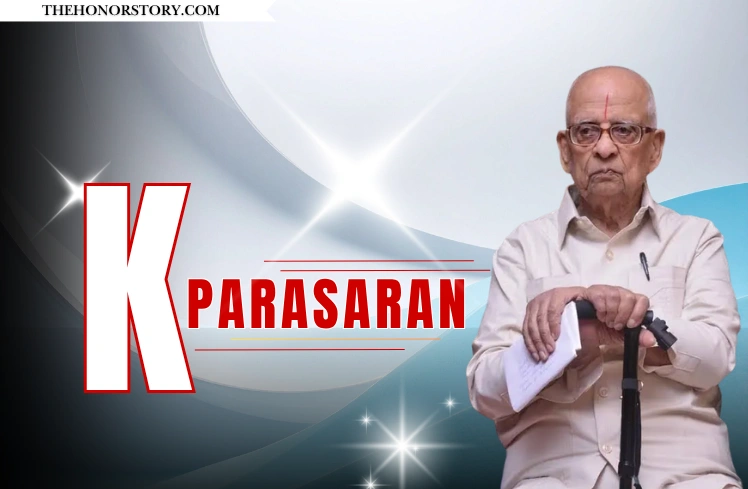
Most of us panic when we have to appear before a single school teacher. Imagine walking into the Supreme Court of India at 92 years of age, standing barefoot before a five-judge Constitution Bench, and arguing one of the most fiercely contested legal battles in Indian history — for a case you’ve been preparing for over four decades.
And honestly? If his life were a Bollywood film, it would probably win every National Award and make grown adults ugly-cry in the theatre.
Keshava Parasaran — more formally known as K Parasaran — is not just a lawyer. He is a phenomenon. He is the man who has argued cases across every government since Indira Gandhi, advised Prime Ministers without fearing them, stood up to the Establishment when it was wrong, and still found time to recite verses from Valmiki’s Ramayana every single morning. At 98.
So whether you’re a law student looking for inspiration, a curious reader who stumbled across the Ayodhya verdict, or someone who Googled “K Parasaran” after seeing his name in the news — welcome. You’re in for a treat.
Quick Stats: Who Is K Parasaran?
| Detail | Information |
|---|---|
| Full Name | Keshava Parasaran |
| Date of Birth | 9 October 1927 |
| Place of Birth | Srirangam, Tamil Nadu, India |
| Current Age | 98 years |
| Education | B.A. Economics, Presidency College, Chennai; B.L., Law College, Madras |
| Legal Career Began | 1950 (Madras High Court); 1958 (Supreme Court of India) |
| Notable Positions | Advocate General of Tamil Nadu (1976–77), Solicitor General of India (1980–83), Attorney General of India (1983–89) |
| Rajya Sabha | Nominated Member, 2012–2018 |
| Awards | Padma Bhushan (2003), Padma Vibhushan (2011), Most Eminent Senior Citizen (2019) |
| Famous Cases | Ayodhya Land Dispute, Sabarimala Temple Entry |
| Nickname | “Pitamah of the Indian Bar” |
| Estimated Fees | ₹10–12 lakh per court appearance |
| Children | Three sons (Mohan, Satish, Balaji) and two daughters |
| Religion/Faith | Devout Hindu; follower of Lord Parthasarathy |
The Boy from Srirangam Who Would Change India
- Every great story has a humble beginning, and K Parasaran’s is no different — except it comes with Sanskrit medals, a Vedic scholar for a father, and a childhood routine of reciting the Ramayana.
- Born on 9 October 1927 in the holy temple town of Srirangam, Tamil Nadu, Keshava Parasaran came from a deeply religious and intellectually gifted family. His father, R. Kesava Aiyangar, was not just a lawyer but also a Vedic scholar who practised at the Madras High Court and, later, the Supreme Court. The apple did not fall far from the banyan tree.
- Young Parasaran completed his schooling at The Hindu Higher Secondary School in Chennai in 1942. He then enrolled at the prestigious Presidency College in Chennai, where he earned a Bachelor of Arts degree in Economics in 1946. What did he do next? He got a job at Madras University.
- Now, here’s where the plot twist happens. Most people would have been quite happy with a university job. Not Parasaran. He resigned, sat for the Bar Council examination, and — in the most overachiever move possible — won the Justice Shri K.S. Krishnaswamy Iyengar Medal for topping the exams.
- He had also bagged the Shri Justice C.V. Kumaraswami Sastri Sanskrit Medal and the Justice Shri V. Bhashyam Iyengar Gold Medal in Hindu Law during his B.L. course. The man was basically collecting medals like most of us collect notifications on our phones.
- He began his practice at the Madras High Court in 1950 and moved to the Supreme Court of India in 1958. The rest, as they say, is history — except when the history involves arguing cases barefoot, which we’ll get to.
A Legal Career That Spanned Seven Decades (And Three Prime Ministers)
- Here’s a fun exercise. Think of three Prime Ministers of India. Now imagine being the go-to legal brain for all of them — across party lines, across decades, across political climates. That’s K Parasaran for you.
- He was appointed Advocate General of Tamil Nadu in 1976 during the Emergency. In 1980, he became the Solicitor General of India under Indira Gandhi. Then from 1983 to 1989, he served as the Attorney General of India — under both Indira Gandhi and Rajiv Gandhi.
- But here’s what makes this man genuinely extraordinary: he never became anyone’s yes-man.
- In 1985, while serving as Solicitor General, Parasaran advised the Indira Gandhi government not to proceed with demolishing the Indian Express building. He clearly stated it was legally untenable. The government ignored his advice. His response? He flatly refused to defend the government in court and offered to resign rather than argue a case he believed was wrong.
- The Indira Gandhi government, rather than accepting his resignation, promoted him to Attorney General of India within two months. Let that sink in: he stood up to the Prime Minister’s government, refused to budge, and got promoted for it.
- That’s integrity so strong it practically has its own gravitational field.
- He co-established the Revenue Bar Association (RBA) in Chennai in 1963, was appointed Senior Standing Counsel in the Madras High Court by the Union government in 1971, and during the NDA tenure of 1999–2004, Prime Minister Atal Bihari Vajpayee appointed him to the National Commission to Review the Working of the Constitution (NCRWC).
The Ayodhya Case: When a 92-Year-Old Became India’s Legal Superhero
Let’s talk about the moment that cemented K Parasaran’s legacy for generations.
- The year is 2019. The Supreme Court is about to hear the final arguments in one of the most politically and religiously charged land disputes in Indian history — the Ram Janmabhoomi-Babri Masjid title suit. Five judges. Forty days of hearings. The entire nation holding its breath.
- And standing at the front row, barefoot, reciting Sanskrit shlokas from memory, is a 92-year-old man who has been preparing for this very moment for over forty years.
- K Parasaran appeared as the lead counsel for Ram Lalla Virajman — the infant deity as a legal entity. He had never truly let go of this case, even after semi-retiring in 2016. His juniors later revealed that he had been preparing for it “as and when it would be argued” throughout what was supposedly his retirement.
- His arguments were nothing short of spectacular. One of his most quoted lines during the hearing: “Muslims can pray in any other mosque in Ayodhya. There are 55–60 mosques in Ayodhya alone. But for Hindus, this is the birthplace of Lord Ram, which we cannot change.”
- He also drew a memorable parallel to the Muslim side’s argument of “once a mosque, always a mosque,” responding firmly: “I will say — once a temple, always a temple.”
- During the hearings, in a moment that moved many people in the courtroom, he said: “My last wish before I die is to finish this case.”
- On 9 November 2019, the Supreme Court delivered its unanimous verdict — awarding the disputed land to the Hindu side for the construction of a Ram Temple. As the Chief Justice of India Ranjan Gogoi read out the historic decision, K Parasaran sat in the front row, composed, eyes glistening.
- Minutes later, he walked out of the courtroom, surrounded by jubilant lawyers, and quietly allowed people to photograph him on their phones. No theatrics. No victory dances. Just quiet dignity — the mark of a true giant.
- He was subsequently named as the first trustee of the Shri Ram Janmabhoomi Teerth Kshetra Trust, which oversees the construction of the Ram Temple. The trust’s registered office was established at his own home — R-20, Greater Kailash Part I, New Delhi. His son Mohan Parasaran is fond of saying that the “R” in R-20 stands for “Ram.
K Parasaran Fees: What Does It Cost to Hire India’s Legal Pitamah?
Let’s address the question that law students, litigants, and curious people alike are burning to know: how much does K Parasaran charge?
- Well, if you have to ask, you probably can’t afford it. But let’s talk numbers anyway.
- K Parasaran Fees are estimated at approximately ₹10 lakh to ₹12 lakh per court appearance at the Supreme Court and High Courts. Some reports place the figure as high as ₹12 lakh per sitting for major constitutional matters.
- His annual earnings are broadly estimated to be in the ₹8 to ₹10 crore range during his active years — making him consistently one of the highest-paid lawyers in India.
- Now, before you choke on your chai, consider what you’re paying for:
- Seven decades of legal experience
- A man who has argued before the Supreme Court since 1958
- Someone who has served as both Solicitor General and Attorney General of India
- A lawyer who can cite the Ramayana, the Upanishads, and constitutional precedents in the same argument — without pausing to breathe
- K Parasaran Fees for Ayodhya, interestingly, were a subject of quiet admiration in legal circles. Despite the enormity of the case and its emotional significance to him, Parasaran reportedly approached it not as a commercial mandate but as a personal pilgrimage. His junior Advocate Aniruddh Sharma stated publicly that for Parasaran, “it was not a fight. It was a pilgrimage.”
- Parasaran himself, ever the principled man, has publicly urged senior advocates to charge “only what is necessary” — noting that some lawyers now charge what he called “a king’s ransom” and that this trend was concerning. The man who arguably commands some of the highest fees in the country was telling his colleagues to chill out. Iconic.
Family, Faith, and the Tragedy That Life Didn’t Spare
- No portrait of K Parasaran is complete without understanding the man behind the lawyer — his family, his faith, and the personal losses that tested him.
- Parasaran married Shrimati Saroja Parasaran in 1949. She was, by all accounts, his quiet anchor through seven decades of courtroom battles and public life. Tragically, she passed away on 6 July 2010 at the age of 75. The loss of his lifelong companion was immense — a personal tragedy for a man who had, by then, argued thousands of cases but had never argued with fate.
- The couple had five children — three sons (Mohan, Satish, and Balaji) and two daughters (Rangam Balaji and Vasupradha). In a remarkable dynastic achievement, all three sons became lawyers. Mohan Parasaran went on to serve as the Solicitor General of India under the UPA-II government from 2013 to 2014. Satish Parasaran is a Senior Advocate and a Tamil Nadu Bar Council member. Balaji Parasaran also practices law.
- The family’s legal legacy extends even further — the fourth generation of Parasarans has also joined the Bar. That’s four generations of lawyers from one family. The courtroom is essentially their ancestral home.
- The subject of K Parasaran Son Tragedy circulates online, and it’s important to address this with care. The most documented grief in Parasaran’s personal life is the loss of his wife Saroja in 2010. While no specific publicly verified incident matches the exact phrase “K Parasaran Son Tragedy” in confirmed news records, the family has not been untouched by personal loss — including the death of Saroja, who was a central pillar of the family. Readers seeking specifics should consult verified news sources rather than rely on unverified claims.
- What is beyond dispute is that through personal grief, professional pressures, and the weight of age, K Parasaran has continued to carry himself with remarkable grace.
- His faith has been his foundation. Since his early thirties, he has recited verses from Valmiki’s Ramayana every day. He is a devoted worshipper of Lord Parthasarathy (Lord Krishna), and at the entrance to his home-office in Greater Kailash is a large poster of Venkatakrishnan deity. His home, in every photograph and every account, looks less like a lawyer’s residence and more like a temple — filled with paintings of Krishna, Radha, and Ram.
Awards, Honours, and a Nickname That Says It All
Let’s do a quick roll-call of what K Parasaran has earned across nearly a century of living and working:
- Padma Bhushan — 2003, Government of India’s third-highest civilian honour
- Padma Vibhushan — 2011, Government of India’s second-highest civilian honour
- Presidential Nomination to Rajya Sabha — 2012 to 2018
- Most Eminent Senior Citizen Award — Presented by Vice President Venkaiah Naidu in October 2019
- Shri Narayan Guru Award (Swarajya Award) — 2020
- Justice Shri K.S. Krishnaswamy Iyengar Medal — Bar Council of India examinations
- Justice Shri V. Bhashyam Iyengar Gold Medal in Hindu Law — B.L. examinations
- “Pitamah of the Indian Bar” — Conferred by former Chief Justice of Madras High Court, Justice Sanjay Kishan Kaul
- That last one — Pitamah — is not an official state honour. It’s something far more meaningful: it’s what the legal fraternity calls him, with genuine reverence. Pitamah means “grandfather” in Sanskrit. It’s the title given to the most respected, most senior, most venerable elder — the one everyone looks up to.
- A book titled “Law and Dharma: A Tribute to the Pitamaha of the Indian Bar” was authored by three students of SASTRA University and released in his honour in 2016. Three law students wrote an entire book about a man who was still very much alive and still arguing cases. That’s the kind of impact we’re talking about.
- K Parasaran is also known to have appeared against eminent jurists like Nani Palkhivala in crucial constitutional cases — another sign of the extraordinary calibre of legal contest he was consistently part of.
Conclusion: A Life That Is Itself a Legal Argument — For Integrity
- If you strip away all the titles, the medals, the Rajya Sabha seat, and the ₹10–12 lakh per hearing fees, what you’re left with is something much more powerful: a man who chose dharma over convenience every single time.
- K Parasaran refused to defend a government he believed was wrong — and got promoted for it. He argued the Ayodhya case at 92 not for money but because it was his life’s calling. He started every morning for decades with verses from the Ramayana. He urged fellow lawyers to not overcharge clients, even while being one of the costliest advocates in the country.
- He is proof that greatness and goodness are not mutually exclusive. That you can be at the absolute top of your profession and still not lose your soul.
- At 98 years old, K Parasaran has lived a life so full, so committed, and so principled that it makes most of our five-year plans look like rough drafts.
Read More:
- Thehonorstory
- Raj Nidimoru
- Saikhom Mirabai Chanu
- Chitra Tripathi
- Sanket Upadhyay
- Sonam Wangchuk Net Worth
- Princess Leonor
Frequently Asked Questions
Q1. Who is K Parasaran?
K Parasaran (Keshava Parasaran) is a senior advocate at the Supreme Court of India, born on 9 October 1927 in Srirangam, Tamil Nadu. He served as Attorney General of India from 1983 to 1989 and is best known for arguing the Ayodhya land dispute case in 2019 at the age of 92.
Q2. What is K Parasaran’s fee per hearing?
K Parasaran Fees are estimated at approximately ₹10 lakh to ₹12 lakh per court appearance, making him one of the highest-paid lawyers in India. His annual earnings during active years were estimated between ₹8 to ₹10 crore.
Q3. What was K Parasaran’s role in the Ayodhya case?
K Parasaran served as the lead counsel for Ram Lalla Virajman (the presiding deity as a legal plaintiff) in the Ram Janmabhoomi-Babri Masjid title dispute. He argued the case at age 92 and the Supreme Court delivered a unanimous verdict in favour of the Hindu side on 9 November 2019.
Q4. What are K Parasaran’s major awards?
He has been awarded the Padma Bhushan (2003) and the Padma Vibhushan (2011) by the Government of India. He was also nominated to the Rajya Sabha by the President of India in 2012, and received the “Most Eminent Senior Citizen Award” in 2019.
Q5. What is meant by “Pitamah of the Indian Bar”?
The title Pitamah means “grandfather” in Sanskrit and is a term of the highest reverence. It was bestowed on K Parasaran by the legal fraternity, particularly attributed to former Chief Justice of Madras High Court, Justice Sanjay Kishan Kaul, recognising Parasaran’s unmatched contribution to Indian law.
Q6. Who are K Parasaran’s sons?
K Parasaran has three sons — Mohan Parasaran (former Solicitor General of India, 2013–2014), Satish Parasaran (Senior Advocate and Tamil Nadu Bar Council member), and Balaji Parasaran (also a lawyer). The family’s fourth generation has also joined the legal profession.
Q7. What is the K Parasaran Son Tragedy?
The topic of K Parasaran Son Tragedy is widely searched online. The most documented personal grief in his life includes the passing of his wife Saroja Parasaran on 6 July 2010. For any specific verified incidents, readers are advised to consult reliable news sources.
Q8. Did K Parasaran argue barefoot in court?
Yes. It has been widely reported that during the Ayodhya hearings in 2019, K Parasaran argued barefoot before the Supreme Court’s Constitution Bench — a gesture of deep spiritual reverence for the case he considered a pilgrimage, not a professional matter.
For more verified information, you can refer to this trusted external source: Officer Life Path
